The UK Nature’s Rights Bill: A guest blog by Mumta Ito
What if our laws were designed not just to limit environmental destruction, but to create the conditions for nature, people and the economy to flourish as one interconnected living whole?
In this guest blog, Mumta Ito from Nature’s Rights introduces the proposed UK Nature’s Rights Bill, exploring why it is needed, what it hopes to achieve and how people can help build support for recognising and protecting the rights of nature in law.
This blog is useful background reading ahead of our joint "Nature’s Rights x Hope for the Future: Briefing & Campaign Workshop" on Wednesday 18 November, 1–2pm GMT, where we'll explore the Bill and how Hope for the Future can provide support to helping you engage your local politicians.
 Written by Mumta Ito, Founder of Nature’s Rights, Architect of the Integrated Rights Framework and Author of the UK Nature’s Rights Bill
Despite decades of environmental legislation and conservation efforts, nature continues to decline. In January 2026, even the UK Government's national security assessment warned that biodiversity loss and ecosystem collapse threaten Britain's security and prosperity.
What if the problem isn't simply inadequate environmental protection, but something fundamentally wrong with our legal system itself?
The missing foundation in our laws
Our legal system is built on a fundamental separation between nature, human society and the economy, even though they exist as interdependent parts of one living whole.
Nature is predominantly treated as property or a resource. Human rights operate within a separate legal framework, while corporate, property and economic rights are supported by powerful legal and financial structures.
Yet reality is different.
Without nature, there can be no people. Without people, there can be no economy.
Just as a building cannot survive the destruction of its foundations, neither human wellbeing nor economic prosperity can endure if we destroy the living systems that sustain them.
Yet our laws can make the destruction of those very foundations lawful, financeable and profitable.
Beyond conventional Rights of Nature
A growing global Rights of Nature movement is challenging this paradigm. The UN Harmony with Nature programme has helped advance international recognition, while the Eco Jurisprudence Monitor documents over 700 Rights of Nature and related ecological law initiatives worldwide.
But recognising Nature's rights alone does not necessarily change the legal and economic structures driving its destruction.
After more than a decade of legal research and practical stakeholder engagement, I developed the Integrated Rights Framework (IRF) to address this fundamental problem.
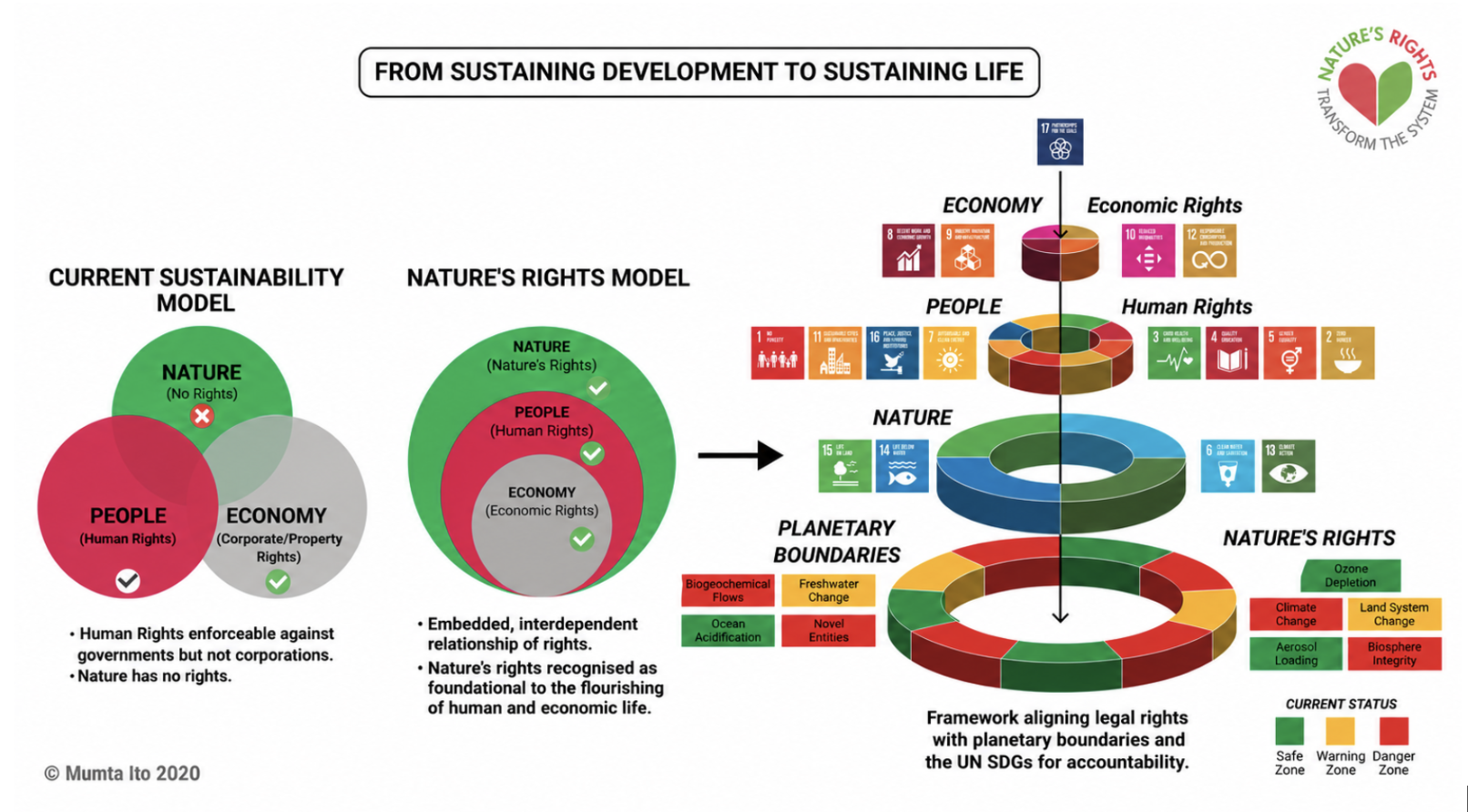
Diagram: From the conventional sustainability model to the Integrated Rights Framework. Copyright: Mumta Ito, Nature’s Rights
The IRF goes beyond granting rights to Nature. It establishes a non-adversarial, relational framework integrating Nature's rights, human rights and economic rights with corresponding legal duties, responsibilities and practical implementation mechanisms.
Nature's rights are foundational because they protect the ecological conditions necessary for human life, rights and prosperity. Rather than treating these as competing interests, the Framework restructures their legal relationship to support the wellbeing and regeneration of the interconnected whole.
Crucially, it operates primarily upstream - shaping laws, policies, investment and decision-making to prevent harm, rather than relying predominantly on litigation or repairing damage afterwards.
The fundamental question changes from "How much environmental damage can we permit?" to: "How can we meet human and economic needs while maintaining and regenerating the living systems on which we depend?".
A historic opportunity in Parliament
This approach has now been translated into the UK Nature’s Rights Bill, introduced by Baroness Natalie Bennett in June 2026.
The Bill establishes Nature's rights alongside duties of care, integrating them across law, governance, planning, business and finance. It provides practical mechanisms including Rights Impact Assessments, ecological guardianship, bioregional governance, non-adversarial dispute resolution and phased implementation.
The House of Lords Delegated Powers and Regulatory Reform Committee recognised its extraordinary significance, stating:
"If passed, the Bill would be one of the most consequential Acts of Parliament this century" - House of Lords Delegated Powers and Regulatory Reform Committee, September 2026.
The Bill has completed Second Reading and is progressing towards Committee Stage. As the first national legislative prototype of the IRF, it also offers a blueprint for international adoption.
Your voice can help make this happen
Hope for the Future's work demonstrates the importance of citizens engaging with their elected representatives.
Here are three ways to help:
Attend "Nature’s Rights x Hope for the Future: Briefing & Campaign Workshop" on Wednesday 18 November, 1–2pm GMT, where we'll explore the Bill and how Hope for the Future can provide support to helping you engage your local politicians. Sign up here!
Write to your MP. Ask them to sign Early Day Motion 562, supporting the Nature’s Rights Bill.
Mobilise your networks. Invite organisations to sign the Civil Society Statement of Support through Nature's Rights.
We have spent decades trying to repair the damage caused by systems that treat nature as expendable. Now we have an opportunity to change the rules themselves - and establish the legal foundations for a regenerative society.